

The Shed That Never Quite Fits
You've probably stood in front of a shed at the local hardware store and thought, close, but not quite. Maybe it's too shallow for your ride-on mower. Maybe the door swings the wrong way for your gate. Maybe it's made from thin steel that dents if you look at it sideways, and you know a Tasman nor'wester will have the roof rattling by winter.
Off-the-shelf sheds are built for everyone, which means they're rarely built for you. That's the honest problem: mass-produced sheds solve a generic storage need, not your actual backyard, your actual gear, or your actual plans for the space.
A bespoke timber shed flips that around. Instead of squeezing your life into a standard box, you design the box around your life. Below are twelve ways Tasman homeowners are doing exactly that.
Bespoke sheds are built to your exact size, layout and site, not a factory template.
You choose the timber species, cladding style and finish to match your home and the local climate.
Add-ons like windows, insulation, wiring and lofts turn a shed into a workshop, studio or extra room.
Roofing, doors and outdoor extras like decking let you finish it exactly how you imagined it.
Custom builds cost more upfront than kitset options but last longer and add real property value.
Key Takeaways
A bespoke shed is designed around your section, not the other way around.
Twelve customisation areas — size, timber, cladding, windows, insulation, wiring, doors, roofing and more — let you shape a shed for exactly how you'll use it.
Local timber choices matter more in Tasman's climate than most people expect.
Small additions like a deck or veranda can turn a shed into genuine extra living space.
Custom costs more upfront but tends to outperform kitset builds on both durability and resale appeal.
What "Bespoke" Actually Means for a Shed
Bespoke simply means made to order, from the ground up, around your brief. Nothing is pulled off a shelf. A builder measures your section, asks how you'll use the space, and designs a structure that answers those questions directly — not a structure that happens to be close enough.
For Tasman backyards specifically, this matters more than most people realise. Sloped sections, exposure to coastal wind, and the sunny-but-wet swings of the local climate all affect how a shed should be built. A generic kitset doesn't know your section. A local, custom build does. That's also why so many homeowners in the region now start with a timber sheds guide before deciding between a kitset and a fully custom design.
12 Ways to Make Your Shed Truly Yours
Size and Layout, Built Around Your Land
1. Made-to-measure dimensions. Instead of choosing the nearest standard size, you set the exact footprint. This matters most on tight or awkward sections, where even 300mm can be the difference between a shed that fits and one that blocks your side access. A best shed placement guide is worth reading before you finalise dimensions, since placement and size decisions go hand in hand.
2. Multi-room layouts. A single shed can hold two very different lives at once — say, a tool bay on one side and a quiet workshop on the other, each with its own door. Internal partitions let you keep messy jobs and tidy storage apart, which most flat-pack sheds simply can't offer.
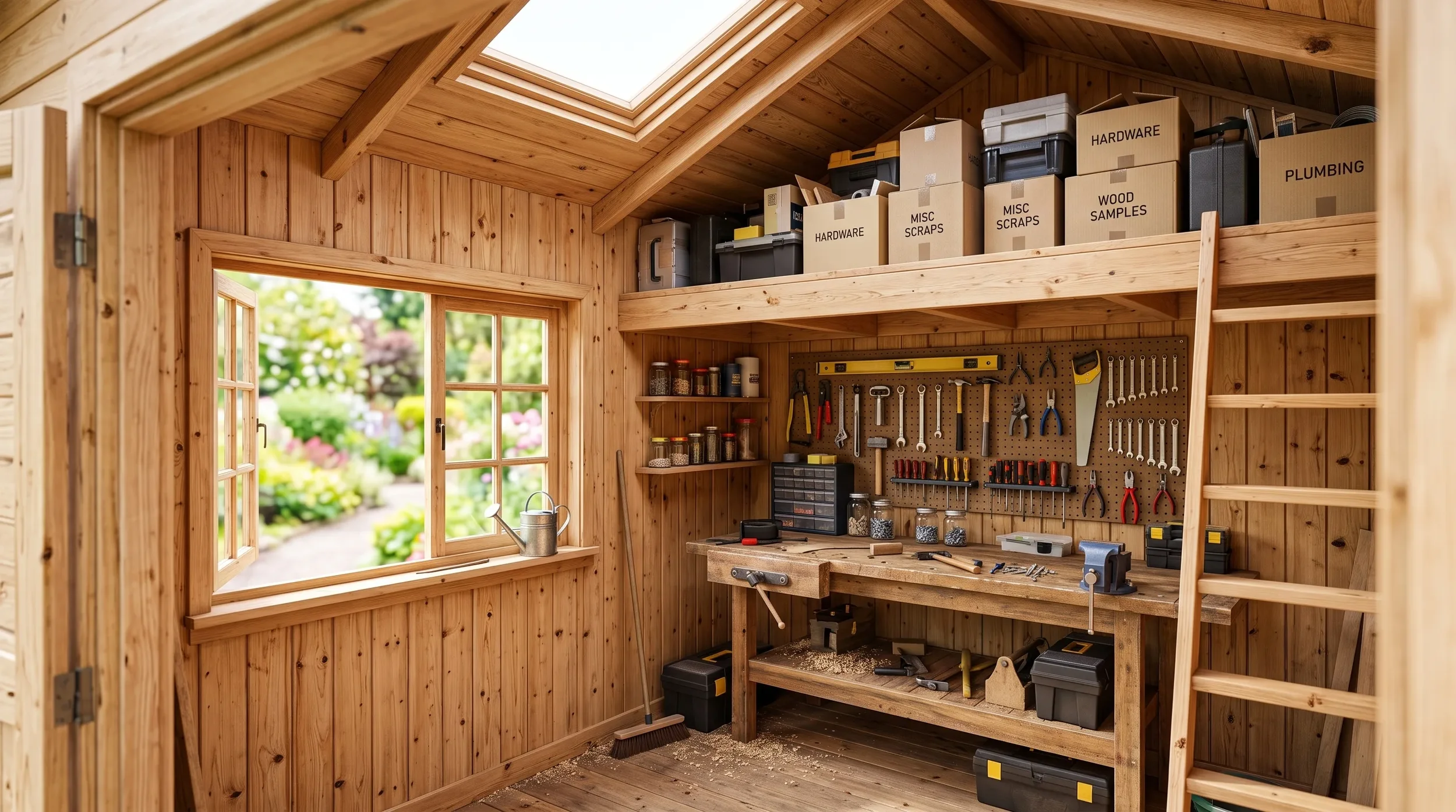
3. Loft and mezzanine storage. Rather than widening the footprint, you can build upward. A loft platform is ideal for seasonal items — Christmas decorations, camping gear, off-season tools — freeing up the floor for things you use every week.
Timber and Cladding, Chosen for the Nelson Climate
4. Choice of NZ timber species. Macrocarpa, cedar and redwood all behave differently in weather, cost, and appearance. Picking the right one changes how the shed ages over the next twenty years. If you're unsure which suits your section, the redwood vs cedar vs macrocarpa comparison breaks down the practical differences in plain terms.
5. Weatherboard or board-and-batten cladding. Cladding style does more than decorate — it affects how the shed sheds water and how much upkeep it needs. Board-and-batten gives a rustic, farmhouse look that suits lifestyle blocks, while horizontal weatherboard reads as tidier and more traditional, matching many Richmond and Nelson homes.
6. Natural or stained timber finishes. You can let the timber silver naturally over time, or apply a stain that keeps the original colour and matches your house or fence line. This is a small decision with a big visual impact, since it's the first thing anyone notices from the driveway.
Function First: Add-Ons That Change What the Shed Can Do
7. Windows and skylights. Natural light turns a dark storage box into a space you actually want to spend time in — essential if the shed will double as a workshop, studio, or reading nook. Skylights work particularly well on narrower sheds where wall space for windows is limited.
8. Insulation for year-round use. Without insulation, a timber shed is a summer sauna and a winter icebox. Adding it — even just to the walls — makes the space usable in every season, which is the difference between a "garden shed" and a proper garden office or outdoor studio.
9. Power and lighting wiring. Running power out to the shed, ideally planned and fitted during the build rather than added later, opens up everything from charging tools to running a heater or a small fridge. It's far cheaper to wire in from day one than to retrofit through finished walls.
Style and Finishing Touches
10. Custom doors and hardware. Barn-style sliders, double doors wide enough for a ride-on mower, or a simple ledged door with a heritage latch — the door sets the tone for the whole structure and affects daily usability far more than people expect.
11. Roofing style options. A gable roof suits a classic look and sheds rain efficiently, while a skillion (single-slope) roof gives a more modern profile and pairs well with skylights. Roof pitch also affects loft headroom, so it's worth deciding early.
12. Decking, verandas and outdoor extras. A small deck or covered veranda at the entrance turns the shed into a destination, not just a box you visit to grab a spade. It's also one of the simplest ways to extend usable outdoor living space without a full renovation.

Why Bespoke Beats Off-the-Shelf
A custom shed costs more than a flat-pack kit, and it's worth being upfront about that. What you're paying for is a structure that fits your section on the first try, timber chosen for how it performs in local weather, and a layout that solves your actual storage problem instead of a generic one.
There's also a quieter benefit: a well-built timber shed genuinely adds to your property's value and street appeal, in a way a bare steel kitset rarely does. If you want the numbers behind that claim, the ROI of timber projects in Nelson-Tasman lays it out clearly. And because it's built locally, using timber sourced and milled with local conditions in mind, you get a structure that's been designed for this climate, not a national average.
Ready to Design a Shed That's Actually Yours?
You don't need a finished plan to start this conversation — just a rough idea of what you want the space to do. From there, Plankville's shed team can walk you through timber options, layout ideas, and realistic pricing for your section.
Have a look through Plankville in Action for real completed builds around Nelson and Tasman, or get in touch directly via Contact Us to talk through your backyard and what you'd like the shed to become.
Your Backyard, Built Your Way
A shed shouldn't be the one part of your property you settled for. With the right timber, the right layout and a handful of well-chosen extras, it can become one of the most useful — and best-looking — structures on your section. Start with what's frustrating you about your current storage, and build outward from there.
FREQUENTLY ASKED QUESTIONS
-
The most popular options are made-to-measure sizing, timber species choice (macrocarpa, cedar or redwood), custom cladding styles, added windows or skylights, insulation, and wiring for power. Together these let a shed serve as storage, a workshop, or a garden studio, rather than just a box for tools.
-
Custom builds typically cost more than kitset sheds because of made-to-measure timber and design work. However, they usually offer better durability, a longer lifespan, and higher resale appeal, which often narrows the real cost gap over the shed's lifetime.
-
Look for local timber specialists and builders who offer custom design rather than only pre-cut kitsets. In the Nelson-Tasman region, Plankville designs and builds sheds locally, working directly with you on layout, timber and finish.
-
Options include custom footprint sizing, multi-room layouts, loft storage, timber and cladding choices, windows, insulation, wiring, custom doors, roofline style, and outdoor extras like decking or verandas.
-
Several NZ suppliers offer semi-modular kitset ranges with limited customisation, but fully bespoke design — where size, materials and layout are all built to order — is typically offered by local timber and building specialists rather than national kitset brands.
-
Local timber merchants and custom builders are best placed for personalised sizing, since they can measure your section directly rather than working from standard kitset dimensions. This is especially useful for awkward, narrow or sloped sections.
-
Cost varies widely depending on size, timber species and add-ons like insulation or wiring, so it's best treated as project-specific. A local supplier can give an accurate figure once they know your size, materials and intended use.
-
Common requests include loft storage, skylights, insulated walls, power wiring, wider doors for ride-on mowers, and a small attached deck or veranda. These features turn a basic shed into a genuinely usable extra space.
-
Common NZ timber choices include macrocarpa, cedar and redwood, each with different durability, appearance and cost. Cladding style — such as weatherboard or board-and-batten — is also selected separately from the timber species itself.
-
Start with your local climate and how visible the shed will be from the house, since some timbers weather better and some finishes need more upkeep. A local supplier familiar with Nelson-Tasman conditions can recommend species and finishes suited to your specific section.
